
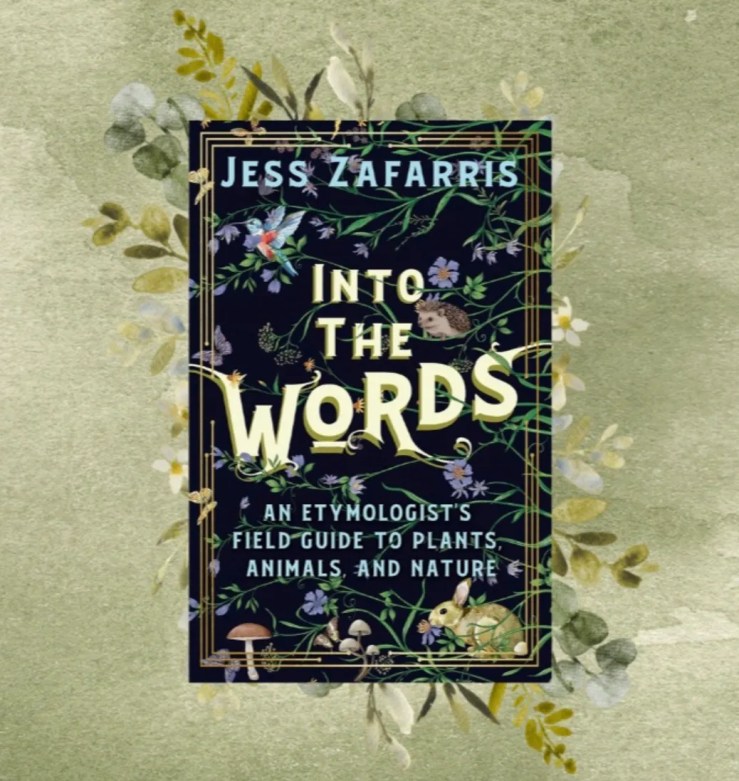
The following is an excerpt from my new book Into the Words: An Etymologist’s Field Guide to Plants, Animals, and Nature.
Botanically, a flower is the reproductive structure of angiosperms, often with petals and sepals, and historically associated with fragrance and beauty. To your average person, they’re a lovely and often fragrant adornment for their personal environment. On a thematically related note, the word anthology was originally a word for a collection of poetry but literally means “a gathering of flowers” (Greek anthos “flower” and logia, here meaning “collection”), suggesting that its contents are like an aesthetically curated bouquet of flowers. And of course an anthology by any other name would smell as sweet. In this little anthology, we’ll learn how a few of them got their names.
Flower and flour were once a single term. Both are from Old French flor, which meant both “blossom” and “the finest portion,” borrowed from Latin florem, the accusative of flos “flower.” In English writing from the 1200s to the 1400s, the two were spelled interchangeably (flour, floer, flor). The idea here is essentially the “best of.” A flower was the best part of a plant; similarly, the finest ground meal sifted from a grain was termed the “flower” of the grain, just as cream was the flower of milk.
The word rose entered Middle English via Anglo-Norman rose, from Latin rosa, a term of uncertain origin possibly borrowed from Greek rhodon or an earlier Mediterranean source. Aside from that connection to “rhododendron” (literally “rose-tree,” with the second element from the Greek dendron “tree”), its etymology isn’t that revelatory because as far back as you can follow it, it just means “rose,” or other flowers and plants that resemble roses. What’s wonderful is how geographically widespread this word’s relatives are. It’s what we sometimes call a Wanderwort, a word that has spread as a loanword among many languages and cultures, especially those that are far away from one another.
The flower name iris is from the Greek îris, meaning “rainbow” (and the name of the goddess who personified rainbows), a nod to the range of colors found in its petals. The iris (or colorful part) of your eye is named according to a similar logic. The genus Iris contains more than 300 species, many of them native to temperate regions of the northern hemisphere.
The word anemone entered English in the 1500s, ultimately from the Greek ánemos “wind.” It has also been called the “windflower,” due to the belief that its delicate petals opened in response to wind or were scattered by it. In some variations of Greek myth, the anemone sprang from the blood of Adonis, or from Aphrodite’s tears as she wept over him. The plant belongs to the buttercup family, Ranunculaceae, and includes several hundred species. The sea anemone is named after the flower based on its physical resemblance. You might even say the sea creature billows under water as the flower does in the wind.
The tulip takes its name from the Ottoman Turkish tülbent, meaning “turban,” due to its turban-like shape, which filtered through the French tulipe (16th century). It is likely ultimately from the Persian dulband, also “turban.” Native to Central Asia, particularly the Tien Shan mountains, tulips were coveted in Ottoman gardens. They also triggered the speculative frenzy of tulip mania in 17th-century Holland. The genus Tulipa was formalized by Linnaeus in 1753, a Latinization of the French term. Tulip poplar refers to Liriodendron tulipifera, a magnolia cousin with tulip-like flowers that’s unrelated to true poplar trees in the Populus genus. Poplars are popular—literally. Poplar is from the Old French poplier, Latin populus “people,” referencing the trees’ prevalence in public spaces in Roman times.
What we now call daffodils go by the botanical name narcissus. In Ovid’s Metamorphoses, Narcissus was a beautiful youth who fell in love with his own reflection in the water. Not realizing it was his, he pined over himself until he died. The flower that bears his name is said to have sprung up where he died, and people who are self-centered are called “narcissistic.” “Daffodil” is from the Dutch de affodil, the Dutch name for the flower, because daffodil bulbs were supplied to Britain for a time by the Dutch. Both are ultimately a riff on the word “asphodel.” Daffodils have also been called affadils (closer to “asphodel”), but also goofier variations such as daffies, daffadillies, daffadowndillies, and daffadoondillies.
But asphodel today is a word for a different kind of plant, one that’s not as glamorous or striking as daffodils. They are also associated with Greek myth, in particular the Asphodel Meadows or Asphodel Fields, the underworld realm where most ordinary souls ended up after death; it’s not as nice as Elysium, but not as horrible as Tartarus. Spirits there just linger. It’s not known exactly what “asphodel” means, but it might mean “fragrant” or “flowery.” Another explanation says the name of the land means “field of ashes,” from the Greek spodós meaning “ashes” or “embers.” Asphodels are said to bloom there because they, too, are muted off-white with a gray and ghostly appearance.
Floral, Flavorful Genitalia
The word orchid entered English in the 1840s thanks to botanist John Lindley as a clipped form of orchidaceous, meaning “belonging to the family Orchidaceae” or “showy or flashy” like many of these enchanting flowers are. This family now encompasses more than 25,000 accepted species and over 100,000 registered hybrids, making it one of the largest plant families. The root of the term is the Greek orkhis meaning “testicle,” referring to the twin, rounded tubers of certain terrestrial orchid species. In Greek, orkhis was also used as a name for certain types of olives, also for their resemblance to testicles. Some orchids bear rather more resemblance to male genitalia than others, particularly the so-called naked man orchid (Orchis italica), whose flowers uncannily resemble human figures with a smaller dangling “appendage” between their legs. Orchids have long been coveted by collectors.
The 19th-century orchid craze, sometimes called orchidelirium, orchidomania, or orchid fever, saw explorers and horticulturalists plundering tropical regions for rare species—with some even dying in the pursuit—and the passion of modern collectors is detailed in Susan Orlean’s narrative nonfiction work The Orchid Thief, which was loosely adapted into the 2002 film Adaptation.
Meanwhile, vanilla is, quite literally, a little vagina, but it’s also from an orchid. The word vanilla entered English from the Spanish vainilla, a diminutive of vaina, meaning “sheath” or “pod,” which is from the Latin vagina, also a word for pods and sheaths—and also a euphemism for what we now call a vagina in English.
Spanish colonists applied the term vainilla (a little pod) to the narrow, elongated fruit of the orchid Vanilla planifolia, native to Mesoamerica and cultivated by the Totonac people of what is now Veracruz. The vanilla orchid (which we now understand to literally mean a “little-vagina testicle”) is pollinated in nature only by specific Melipona bees; cultivating vanilla requires hand pollination in many regions where it is grown today, including Europe and later Madagascar. The cured pods contain vanillin, the primary flavor compound, which must be extracted through months-long fermentation and drying
Read more in Into the Words: An Etymologist’s Field Guide to Plants, Animals, and Nature.
Discover more from Useless Etymology
Subscribe to get the latest posts sent to your email.
