
The lessons I share here are often classifiable as trivia: little bits of information that are of little consequence outside of being curiosities. You might call them “trivialities”—even though I, and most of you, agree that words and their origins are not trivial and do matter a great deal.
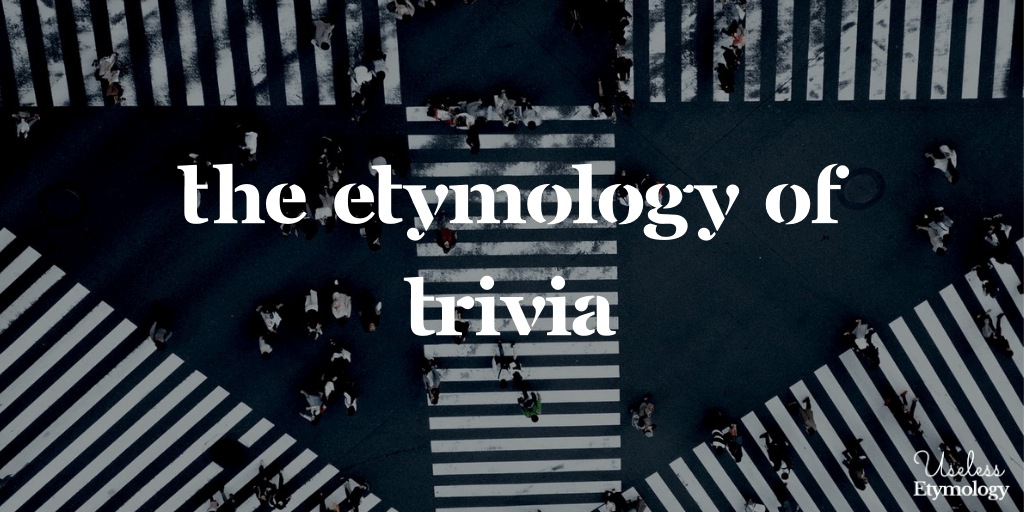
Trivia is a Latin word, the plural of trivium. The related Latin trivialis, meant “common or ordinary.” But the literal meaning of the Latin trivium is “a place where three roads meet.”
What does a three-way crossroads have to do with interesting morsels of mostly useless information?
The Roman Empire was famously connected by public roads, many of which still exist across Europe today, often in much better condition than our contemporary asphalt roads are. The intersections of these roads, especially three or more, were a great place for the public—or plebeians—from different places to meet, hang out, and trade goods. Thus, crossroads came to be known as distinctly public, common places where inconsequential or trivial things were said and done.
The “Trivium” is also a term from Classical education representing the three arts of grammar, logic, and rhetoric. These were the fundamental areas of study before students began studying the more advanced topics of the quadrivium: arithmetic, astronomy, music, and geometry.
“Quadrivium” is the older of the two terms, likely coined by the early medieval philosopher Boethius. However, the idea of grouping these disciplines had been in use long before that and was outlined in the writings of Pythagoras and Plato. “Trivium” was coined a few centuries later, modeled after and paired with the quadrivium during the Carolingian Renaissance. Variations are still in practice in liberal arts contexts today.
The adjective “trivial” appeared in English as early as the 1500s, harking back to the idea of inconsequential news shared by common people but also the idea of fundamental educational disciplines. “Trivia” wasn’t really used in English until 1716, when John Gay published a book by that name about the streets and crossroads of London.
“Trivia” wasn’t a common word for “fun fact” until 1902, when Logan Pearsall Smith published a series of books called Trivia. Smith was known for his clever sayings and essays, and his trivia books were full of interesting little observations about public life and human behavior, like what you might observe at a crossroads.
“Trivia” as a word for gamified fun facts began to crop up in university culture shortly thereafter, and then of course on the quiz shows of the mid-1900s. At that point it was probably meant to be a double entendre, harking back to both the knowledge you would absorb studying the disciplines of the Trivium and the informal news you’d get on the street corner. “Trivia” then got another huge boost in popularity in 1982 with the game Trivial Pursuit. which also alludes to the crossroads in the design of the board.
Lexical links:
Here are some more viable words—that is, words from the Latin via, meaning “way, road, path, highway, channel, course:”
- If something is obvious, it’s clear and easy to see. So easy, in fact, that you might figuratively trip over it—and literally, too—because the word “obvious” literally means “in the way,” or more precisely, “in front of you on the path or road” (ob “in front of, against” + via “way”).
- Impervious (im- “not, opposite of” + per “through” + via “road, way”) describes something resistant to attack, literally because it cannot be penetrated or crossed. There is no way through it.
- Something that happened previously (prae “before” + via “road”) occurred earlier along your route or path.
- To deviate (de “off” + via “way”) is to literally stray from a course, and to be devious or a deviant is to stray from the (moral) path.
- Voyage is a French evolution of the Late Latin viaticum “a journey,” meaning a “journey” along a road.
- To convey something is to carry it along with you or to carry it to someone else, and convoy is a collection of people and vehicles who go along their route together. Both are from the Old French convoiier “to accompany, escort,” made up of com “with, together” + via “way, road.”
- An envoy is someone sent somewhere to represent someone else, and it’s closely related to the word invoice, which you use to request that someone send along payment. Both are ultimately from the Latin inviare, “to send on one’s way,” from in “on” + via “road.”
Discover more from Useless Etymology
Subscribe to get the latest posts sent to your email.
