
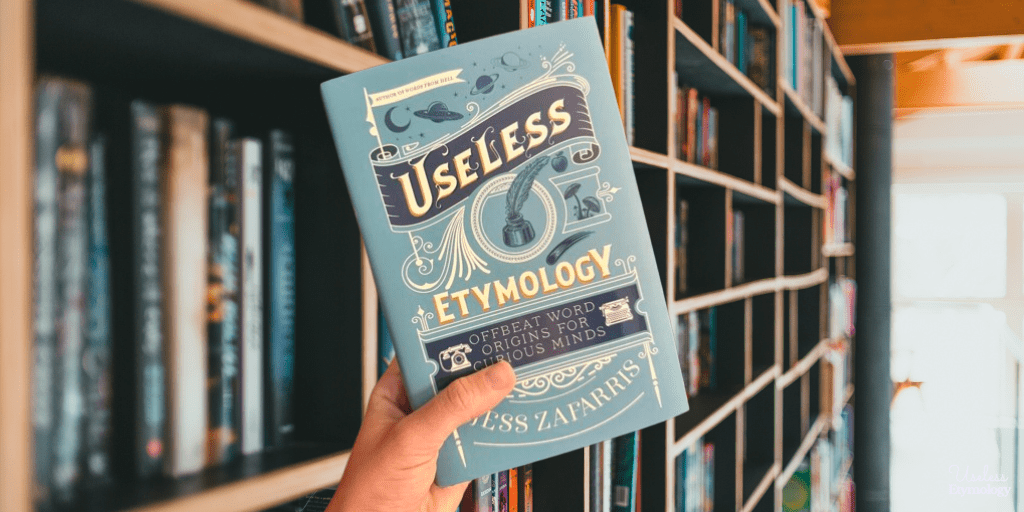
I’m delighted to announce the impending arrival of my third etymology book, Useless Etymology: Offbeat Word Origins for Curious Minds, featuring quirky, charming, and humorous word origin stories for lovers of all things lexical. This lovely little blue book, published by Hachette’s John Murray Press, will be released in hardcover on Oct. 7 in the United States and shortly thereafter everywhere else.
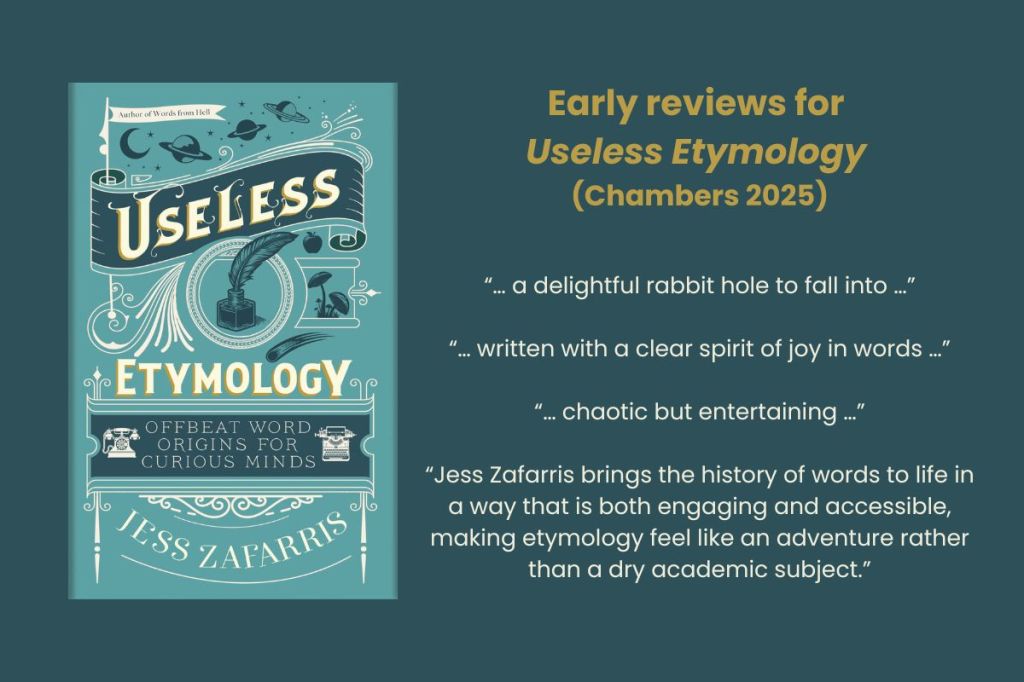
Positive reviews have poured in from the likes of Publisher’s Weekly (“readers may very well feel a sense of superhuman enlightenment”) and Grammar Girl (“A burst of delight on every page!”), as well as everyday readers who say it’s an “utterly fabulous book” that’s “both engaging and accessible, making etymology feel like an adventure rather than a dry academic subject.” An excerpt ran in Harper’s Weekly‘s 175th anniversary issue.
Get a copy of Useless Etymology from Bookshop.org, Amazon, Barnes & Noble, or anywhere you find your next great read.
And read on for a little more about the book!
What’s it about?
• Did you know that an “astronaut” is literally a “star sailor,” that a thesaurus is, in fact, a “treasure trove” of words, and that someone who is “sinister” is actually just “left-handed”?
• Have you ever wondered why English isn’t considered a Romance language if 60% of our words are Latin-derived?
• Did Shakespeare really invent 1,700 words, and if not, why the heck do we say that he did?
• Why is the English language stuffed with so many synonyms?
English can seem a bit inconsistent. And, well, sometimes it is. But through thorough thought and a pinch of curiosity, method can be found within the madness of our modern tongue-even within the disparate pronunciation of the words “through,” “thorough,” and “thought.”
Made up of words derived from Germanic, Romance, Hellenic, Semitic, African and Native American languages, English contains multitudes. It has been (and continues to be) transformed by war and conquest, art and literature, science and technology, love and hate, wit and whim.
Useless Etymology takes readers on a time-traveling adventure to unlock the beauty, wonder, and absurdity within our everyday words, how they came to be, and the unexpected ways their origins weave a global, cross-cultural labyrinth of meaning. Filled with fun facts and delightful discoveries, this is an enlightening read for anyone who wants to know more about why the English language works the way that it does.
Why this book?
About a decade ago, I started this little blog, Useless Etymology. I had studied the development of and major shifts in the English language and their relation to literature, anthropology, and other languages in undergrad. While I was pursuing my Master’s in journalism, I kept rooting around (pun intended) in these words and writing (and making TikToks) about all the wondrous and weird and quirky and entertaining things I discovered.
My first publisher found me and asked me to write a kids’ book, which became Once Upon a Word, and that’s sold something like 30,000 copies.
And then my current publisher, John Murray Press’ Chambers imprint, found me and asked if I wanted to write another book. I pitched two ideas. They accepted both, but they wanted to start with Words from Hell, my book on naughty and nefarious words. And then I finally got to write the book I had already been writing for years, and that’s this silly little beauty called Useless Etymology.
Why would you call it that?
People ask me, “If you love etymology and write about it all the time, what’s with the name? Is etymology really useless?”
Of course it isn’t. That’s a little dig at the fact that some people think it’s not worth studying.
But as I write in the book, etymology gives you superpowers.
Investigating word origins grants you the ability to infer definitions, reveals the interconnectedness of global languages, gives you a doorway into any discipline, and helps you build new words and be more inventive with the ones you already know.
Etymology equips you with the knowledge to wield your words with precision, imagination, and joy in all that is grand and dreadful and hilarious and messy and complicated about being a person.
This little book will head out into the larger very soon, and I hope a copy will grace your bookshelf.
Discover more from Useless Etymology
Subscribe to get the latest posts sent to your email.
