
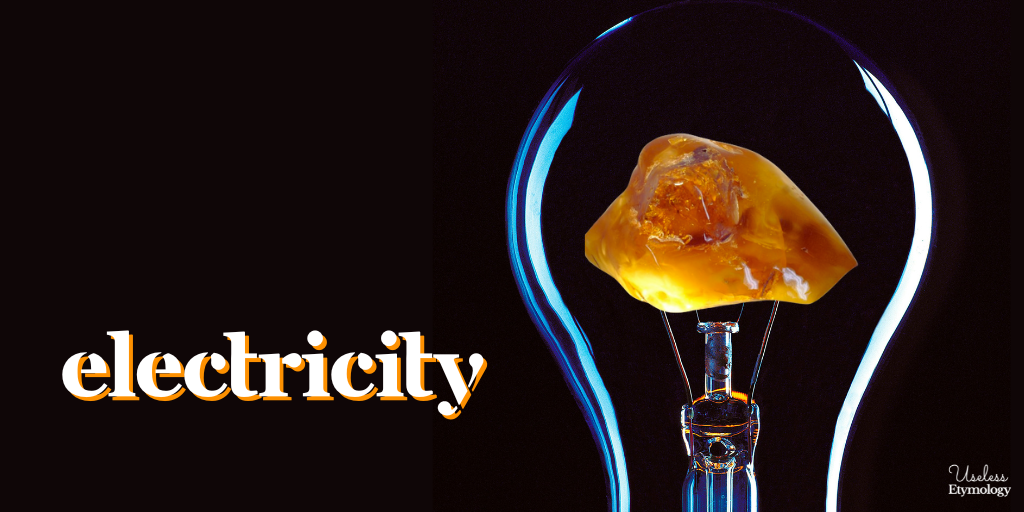
The word “electric” zapped its way into English in the 1600s from the Modern Latin electricus, meaning “resembling amber” (Greek ēlektron, “amber”).
But what does electricity—and what do electrons, for that matter—have to do with fossilized tree resin?
This word came to life thanks to early research into magnetism, as well as the exchange of electrons that makes your hair stand on end and zaps your fingertips when you’ve been walking on carpet in a pair of wooly socks—that is, static electricity.
The Latin electricus first appears in De Magnete, a scientific work published in the year 1600 by William Gilbert on the subject of magnetism.
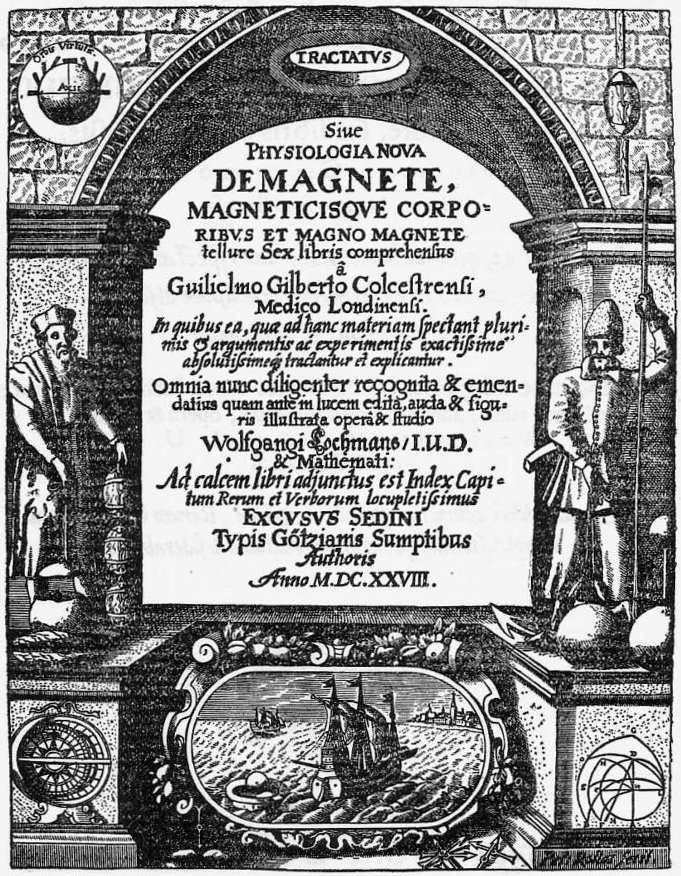
Gilbert chose the Latin electricus to describe the observation that when one rubs amber against some substances like wool or a cat’s fur, it sticks. We now that this clinging—and the zaps that appear between the amber and the substance rubbed against it—is due to static, but at the time, Gilbert supposed amber to be magnetic.
Thereafter, other writers including Francis Bacon used the English word “electric” to describe supposedly (and actually) magnetic materials that attracted other objects.
The noun “electricity” first appeared in 1646 in a work by Sir Thomas Browne, describing the property of some materials to attract lightweight objects when exposed to friction.

Browne, Sir Thomas. Pseudodoxia epidemica (London, 1650)
“Electricity” was to “electric” as “elasticity” was to “elastics”: Materials like amber were said to be “electrics” and have “electricity,” meaning that they attracted other objects, just like “elastics” are objects with “elasticity” or the ability to stretch and bend without breaking.
Although electricity and magnetism (and electromagnetism) are related and fundamentally intertwined phenomena, the distinction between the terms and the usage of “electricity” we know today began to illiuminate in the 1700s.
And then in 1891, Irish physicist George Johnstone Stoney made an indelible mark upon the scientific world as he coined the word “electron” by adding the -on from the word “ion” (introduced by Michael Faraday in 1834) to “electric.”
On a related and perhaps even more shocking note, the word “electrocute” is a portmanteau, first recorded in 1889 in reference to executions by electric chair—as a morbid mashup of “electric” and “execute.”
Discover more from Useless Etymology
Subscribe to get the latest posts sent to your email.

Bright Jess, your rousing words about “electric” keep me current. Thank you.
Dale (from the valley)
LikeLike