
Note: This is an excerpt from my forthcoming book Words from Hell: Unearthing the darkest secrets of English etymology (Chambers, 2023).
As the title says, the word “assassin” literally means “hashish-user”—but it also doesn’t
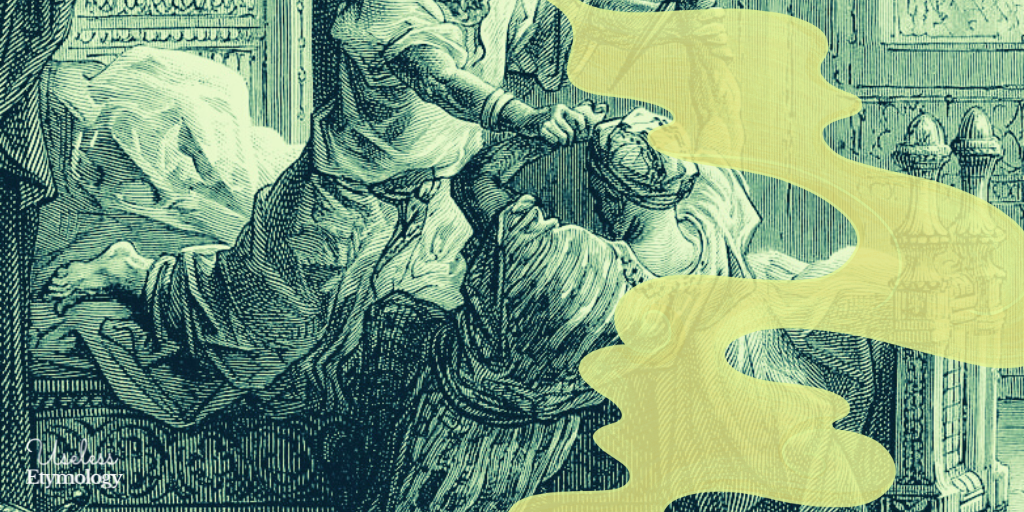
“Hashishin,” the “Order of Assassins,” and “Assassins” alone are Western European names for the Nizari Isma’ili state, a sect of Shia Muslims who lived in a network of mountain strongholds across Persia and Syria from the eleventh to thirteenth centuries. Because they were surrounded by enemies, they established a reputation for employing tactics such as psychological warfare and the covert murders—or assassinations—of rival leaders.
The founder of the sect, Hassan-i Sabbah (ca. 1050–1124), reportedly called his followers Asasiyyun, meaning “principled people” or “people who are faithful to the foundation [of the faith].” In the twelfth century the Fatimid caliph al-Amir bi-Ahkam Allah derogatorily referred to them as hashishi, “hashish-users.” (He was later assassinated by Nizari agents.)
Crusaders and other Western Europeans blended this information into a claim that the Nizari were called hashshashin because they carried out assassinations after smoking or consuming hashish. Marco Polo notably journaled about this process in the 13th century, describing a young man who was put into a trance by a potion made from hashish and sent to assassinate a target.
Beyond these tales, there is no historical evidence that they ever used hashish at all, and especially not that they were involved in any ritual assassinations, but nonetheless the word quickly traveled to Italy and France and then to England.The term hassais cropped up in Middle English, with the spelling evolving and the sense extending, by the 16th century, to today’s general sense of someone who kills based on political or religious motives.
Sources:
- Amin Maalouf, Samarkand (New York: Interlink Publishing Group, 1998).
- Farhad Daftary, The Ismailis: Their History and Doctrines (Cambridge: Cambridge University Press, 1990), p. 13,353.
- Marco Polo, The Travels of Marco Polo, vol. 2, trans. Henry Yule and ed. Henri Cordier. https://www.gutenberg.org/files/12410/12410-h/12410-h.htm
Discover more from Useless Etymology
Subscribe to get the latest posts sent to your email.
